A complex product rarely fails on video because the video was badly made. It fails because someone compressed an entire platform into ninety seconds, and what came out was a montage of features nobody could repeat afterward.
That’s the core problem an AI SaaS explainer video has to solve, and it’s a structural problem before it’s a creative one. A single-feature tool has one story. A platform has twelve, aimed at five different people, sitting at four different points in a buying process. Squeezing all of that into one film produces something that technically covers everything and communicates nothing.
This guide is about cutting the product into pieces that can be explained, then building the right video around each one.
Key Takeaways
- One AI SaaS explainer video cannot carry a whole platform. Complex products need to be broken into explainable units first.
- Four decomposition axes work: by job to be done, by stakeholder, by workflow stage, and by funnel position.
- A software-as-a-service (SaaS) purchase involves several reviewers with different doubts, so one video aimed at all of them usually convinces none of them.
- Integrations belong in the video. Buyers reject products that don’t visibly fit the stack they already run.
- The activation video is the highest-leverage asset most teams never build.
- Ship a system of short, purposeful videos rather than one long tour of everything.
The Platform Trap: Why One Video Can’t Carry a Complex Product
The platform trap is the belief that a bigger product deserves a bigger video. It doesn’t. It deserves more videos, each doing less.
The pull toward one comprehensive film is understandable. Budget is easier to approve once, and every stakeholder wants their module represented. So the script grows, the runtime stretches past three minutes, and each section gets thirty seconds that satisfy no one.
Meanwhile, the audience has widened. McKinsey’s annual survey found that most organizations now report using artificial intelligence (AI) in at least one business function, which means the people evaluating your product are no longer just technical early adopters. They’re operations managers and finance leads with no patience for a platform tour.
A single AI SaaS explainer video covering everything is a decision to explain nothing well.
What Actually Makes an AI SaaS Product Hard to Explain?
Four kinds of complexity cause the trouble, and they need different fixes. Diagnosing which one you have saves an enormous amount of wasted scripting.
Surface area. Several products under one brand, with overlapping use cases. The viewer can’t tell where one ends and the next begins.
Workflow depth. The value only appears after a sequence of steps. Any single screenshot looks unremarkable.
Integration spread. The product’s worth depends on what it connects to, so showing it in isolation understates it badly.
Invisible processing. The model does the interesting part where nobody can watch.
Most teams asking how to explain complex software to customers assume they have a messaging problem. Usually it’s a scoping problem. The script isn’t unclear; it’s overloaded.
Decompose the Platform Before You Write a Single Line
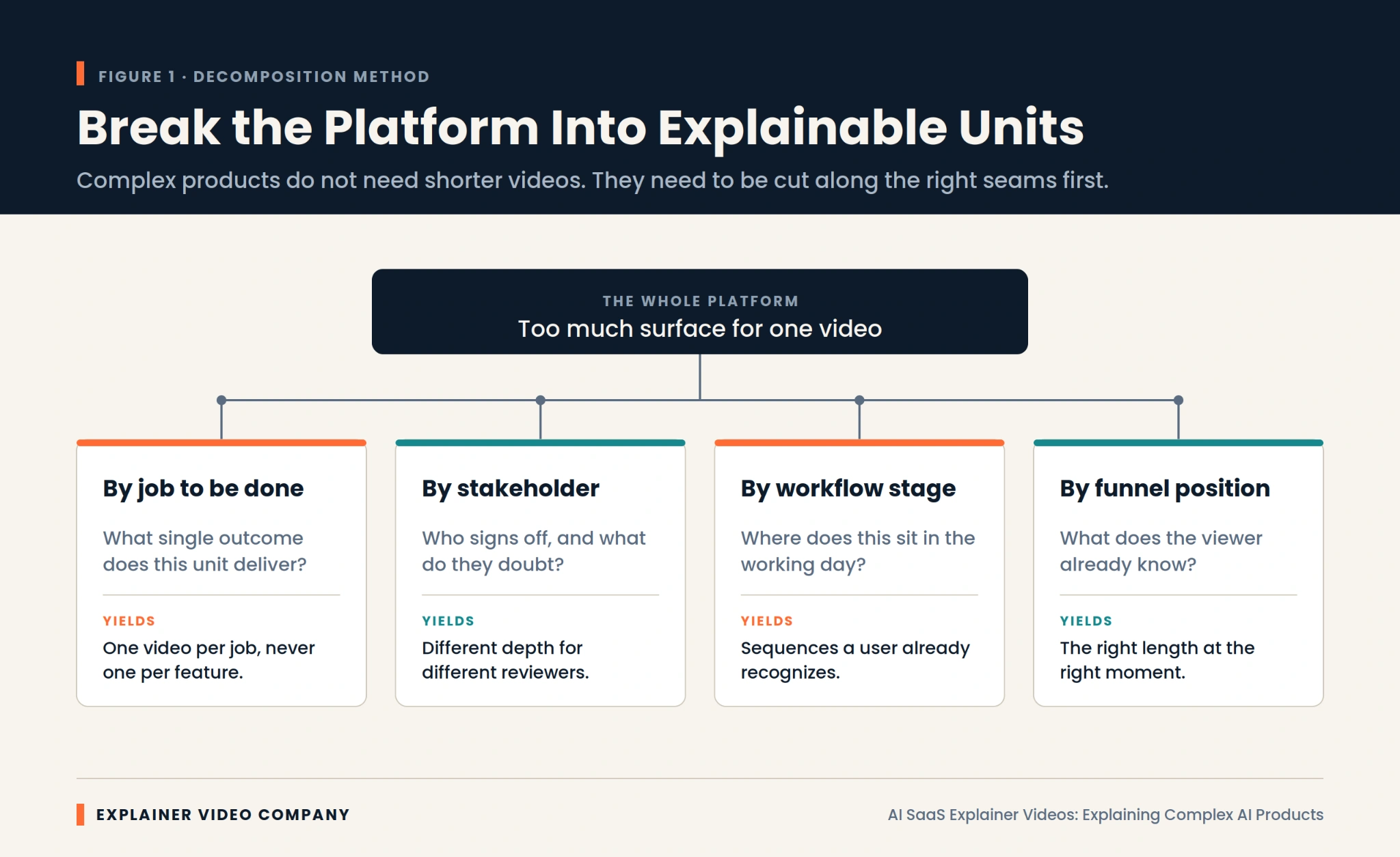
Cut the product along one of four seams before scripting. This is the step that turns an impossible brief into a set of manageable ones.
By job to be done. One video per outcome the customer cares about, never one per feature. Features are how you built it. Jobs are why they buy it.
By stakeholder. Split by who signs off and what each of them doubts.
By workflow stage. Break along the sequence of a real working day, so viewers recognize the shape of it.
By funnel position. Divide by what the viewer already knows when they press play.
Pick one axis and stick to it. Mixing two produces the same mush you started with. Teams wrestling with how to explain a platform with multiple products almost always find the job-to-be-done axis does the most work, and it’s the cut our SaaS explainer video production agency reaches for first.
Which Stakeholder Is This Video Really For?
Name one person before writing, because a complex purchase is never decided by one viewer. Gartner’s research on business buying found that a typical purchase of a complex solution involves a buying group of six to ten decision makers, each arriving with a different fear.
The economic buyer wants to know what it costs to keep doing this manually. Show payback, and keep the interface off-screen.
The technical evaluator wants to know where it breaks. Show real errors and a real recovery path.
The security reviewer wants to know who can see the data. Show permissions, audit trails, and residency.
The end user wants to know whether Tuesday gets easier. Show their exact workflow, before and after.
Write for one of them. The others get their own asset.
Show Where the Product Sits in the Stack, Not Just the Interface
Put the surrounding tools on screen, because nobody buys software that appears to live alone. A buyer watching your interface in isolation is quietly asking whether adopting it means abandoning the six tools their team depends on.
Most product videos skip this, and it costs deals. A thirty-second passage showing data arriving from the systems they already run, passing through your product, and landing back in the tools they already open does more for credibility than another feature sequence.
The trick to explaining software integrations is staying at the level of movement rather than architecture. Nobody needs to see an application programming interface. They need to see the handoff happen without anyone doing it manually.
Clean diagrammatic motion handles this well, which is why a 2D explainer video production company is usually the right partner for stack and workflow sequences.
Map Each Video to a Funnel Stage, Not to a Product Tour
Give every AI SaaS explainer video a stage and a job, because the same footage cannot serve a stranger and a paying customer. That’s the difference between a video and a video system.
At awareness, run sixty to ninety seconds on the problem, with no interface and no feature names. At consideration, take two to three minutes and walk one job start to finish. At trial signup, spend thirty to forty-five seconds on what the first session looks like. At expansion, take two to four minutes on an adjacent job for a neighboring team.
Any sound product-led growth video strategy follows this shape, because the trial itself is doing the selling and video’s role is to remove friction ahead of each step. Our overview of marketing video production covers how these assets get planned as a set rather than commissioned one at a time.
The Activation Video Most SaaS Teams Never Make
Build the video that gets a new user to their first real outcome, because that moment decides retention. Teams pour budget into acquisition films, then leave the post-signup window to a tooltip tour.
Activation is where complex AI products lose people. The user signs up, sees an empty workspace, doesn’t know what good input looks like, and never returns. Nothing failed. They just never reached the point where it worked.
Keep it short and specific. Vidyard’s benchmark data shows engagement falls sharply as business videos get longer, and an onboarding audience has even less patience than a prospect.
Among SaaS onboarding video best practices, the one that matters most is narrowing to a single first outcome and walking it end to end, using real sample data rather than a blank state.
How Much of the AI Should You Actually Explain?
Explain exactly enough for the output to be believable, then stop. There’s a real cost in both directions, which is why the question keeps coming up.
Say too little, and the product reads as a black box the buyer must trust on faith. Say too much, and you’ve built a machine learning lecture that loses everyone in the first minute and still doesn’t close the sale.
The workable middle is one visible layer. Show that the system retrieves from their documents, or that it flags low confidence, or that it routes edge cases to a person. One mechanism, shown rather than narrated.
Depth should also scale with stage. Awareness videos can carry almost none. A security review deserves as much as the reviewer asks for.
Keep One Visual System Across Every Video You Ship
Lock the visual rules before the second video, because assets made piecemeal start looking like several different companies. Once you’re producing five or six videos, consistency stops being a nicety and becomes the thing that makes them feel like one product family.
Fix the palette, the type, the motion timing, the way data appears on screen, and the logo treatment. Write it down. Every later AI SaaS video gets cheaper and faster because those decisions are already made.
The logo animation deserves particular attention since it’s the one element appearing in every asset you’ll ever ship. Our piece on 3D logos that stand out in modern design is worth reading before you settle on a motion signature you’ll be living with for years.
Match the Animation Style to How Much Complexity It Carries
Choose the style by how much information the shot has to hold, not by what looks current. Techniques have genuinely different capacities.
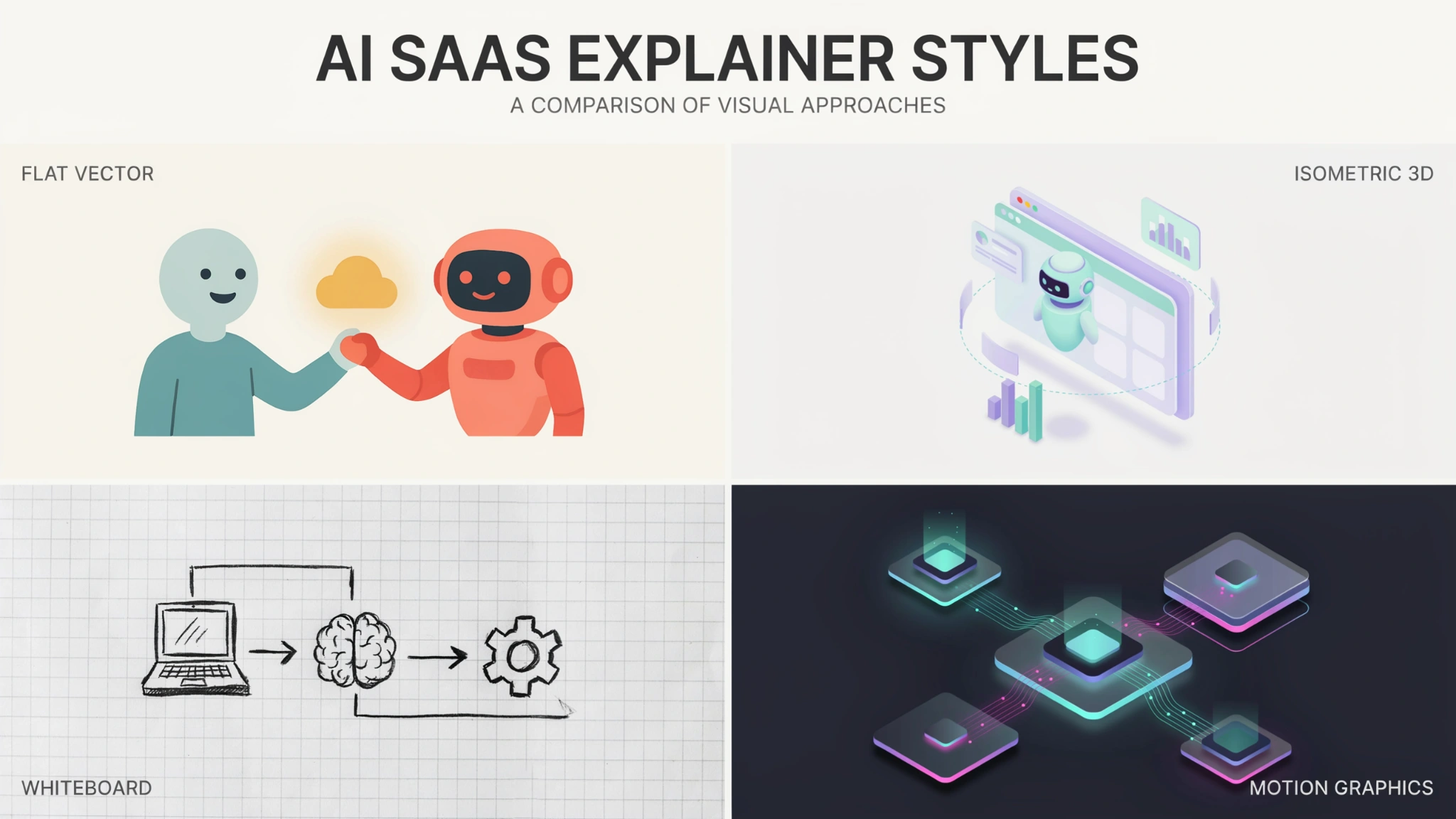
Screen capture carries the most detail and the most proof, but a SaaS explainer video built only from screen capture can’t show anything the interface doesn’t display. Isometric illustration handles systems, stacks, and data movement well, since it shows several connected things at once without clutter.
Kinetic typography carries almost no complexity, which makes it right for a single sharp idea and wrong for a workflow. Character animation carries emotional context and is strongest for the human cost of a broken process.
Deciding what to include in a SaaS product video is largely a question of which of these you’re asking to do the heavy lifting. Our guide to the types of animation breaks down what each one is genuinely good at.
Where 3D Earns Its Place in an AI SaaS Video System
Reach for dimensional work when the story involves layers, scale, or physical context that flat graphics compress into confusion. Most pure software products never need it, and it’s worth saying so plainly.
The exceptions are real. Infrastructure products with stacked architecture, platforms where data moves through several environments, and any AI product touching physical devices all benefit from depth. So does a hero brand film where the goal is presence rather than instruction.
Used well, AI product animation in three dimensions makes an abstract system feel like an object the viewer can walk around. Used decoratively, it just costs more. Our 3D explainer video services exist for the first case, and we’ll usually tell you when you’re in the second.
Final Words
Stop trying to make the one perfect video. A complex AI product is explained by a set of short, purposeful assets that each do one job, not by a single film attempting all of them at once.
The sequence is straightforward. Diagnose your kind of complexity. Cut the platform along one clear seam. Name the single stakeholder each video is for. Assign every asset a funnel stage. Build the activation video everyone else forgets. Lock a visual system so the set feels like one company.
Explainer Video Company plans each AI SaaS explainer video this way, starting with decomposition rather than a script. If your product is more capable than your buyers currently understand, an experienced explainer video production studio will usually find the problem is scope rather than storytelling.
