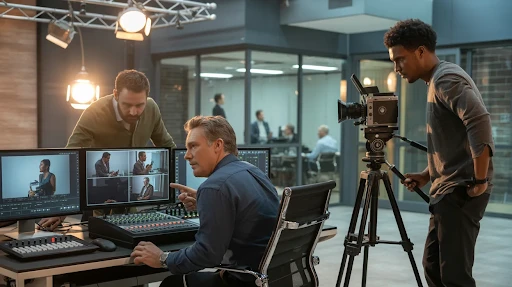
Corporate media production is not just about making a nice company video. It is about developing media that assists a company in explaining something, training a team, selling a service, recruiting better individuals, or making the brand easier to trust.
This might be a homepage video, a customer anecdote, a training clip, a product walkthrough, or a brief internal update.
The trouble starts when a company says, “We need a video,” but no one asks why.
That is how projects get bloated. The script tries to say too much. The visuals look fine, but do not help. The final file gets posted once and then disappears into a folder.
A good corporate video starts with a job.
What Is Corporate Video Production?
Let’s answer it plainly: what is corporate video production?
It is the planning, writing, filming, editing, animation, and delivery of video made for a business purpose. In simple terms, it is the creation of video content that helps a company communicate better.
That purpose can change from project to project. One video might explain a product. Another might train new employees. Another might help sales calls move faster. Another might show job candidates what the workplace is like.
If the message is hard to explain, an explainer video company can help turn it into something clearer. Not just prettier. Clearer. That is the part companies often need most.
Corporate Media Production Needs a Job First
Good corporate media production starts with a boring but important question.
What should this video do?
Not what it should look like. Not what song should it use. Not whether it should feel bold or modern.
Those choices come later.
A video for a recruiting website requires a different tone than a product explanation. A training video shouldn’t sound like a sales pitch. A testimonial should not read like a polished brand speech with a consumer at the center.
This is why a video marketing strategy matters. The video should fit somewhere. A landing page. A sales email. A campaign. A training portal. A recruitment funnel. If no one knows where the video belongs, it usually gets wasted.
Why Businesses Use Corporate Videos
The benefits of corporate video are pretty straightforward.
A video can explain faster than a long page of text. It can show a face, a tone, a process, or a result. It can help a sales team stop repeating the same explanation on every call. It can help employees learn something in the same way instead of hearing five different versions of it.
It also makes a business feel more real. That matters. People trust people before they trust polished claims.
But video is not magic. A weak video still gets ignored. A vague video still confuses people. A video with no real point still feels like filler.
The value comes from making the right thing easier to understand.
When a Simple Video Is Enough
Not every project needs a crew, a scriptwriter, animation, and weeks of editing.
Sometimes basic video creation is fine. A short leadership message. A quick screen recording. A simple internal update. A rough training note for a team that already understands the context.
Simple can work when the stakes are low.
But simple is not the same as careless.
If the video is appearing on your homepage, promoting sales, presenting a high-value offer, or speaking to potential investors, poor sound and editing may make the entire organization feel unprepared. Viewers may not name the problem, but they feel it.
So yes, use a simple video when it fits. Just do not use it where trust is on the line.
When Professional Production Makes Sense
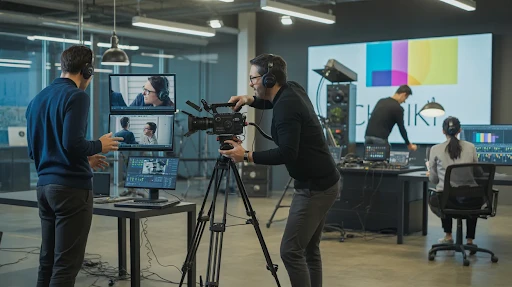
Professional corporate video production makes sense when the video has to carry real weight.
That does not mean the final piece has to feel overproduced. It means the message needs a proper shape. The sound should be clean. The edit should move well. The opening should not waste time. The viewer should understand what is happening without working too hard.
Good production is often invisible. You notice the message, not the effort behind it.
That is the quiet advantage of professionally produced videos. They usually feel more confident because someone has made hard choices. What to keep. What to cut. Where the proof belongs. How quickly the viewer needs the point.
Common Types of Corporate Videos
There are many types of corporate videos, and they should not all be treated the same.
Brand videos introduce the company, its purpose, and its values.
Training videos help employees or customers learn a process.
Recruitment videos show what working with the company feels like.
Testimonials let customers explain the value in their own words.
Event recap videos turn one company event into reusable content.
Promotional videos focus on a specific offer, launch, service, or campaign.
If the product is physical or technical, a 3D explainer video company can help show details that normal footage may miss. Depth, movement, internal structure, product mechanics. Those things can be hard to explain with a flat shot or a paragraph.
The format should follow the problem. Not the other way around.
Why Brand Videos Often Go Wrong
Effective brand videos do not just say, “We are innovative,” “We care,” or “We put customers first.”
Everyone says that.
A better brand video proves something. It shows the people behind the work. It shows what the company believes through real examples. It shows the customer problem that made the business matter in the first place.
Here is a simple test.
Could another company remove your logo, add theirs, and still use the same video?
If yes, the video is probably too generic.
A brand video should feel like it belongs to one company, not an entire category.
Promotional Videos Need Focus
Corporate promotional videos are closer to action. They usually support one product, one service, one campaign, one launch, or one event.
That means they cannot wander.
The audience should rapidly comprehend what is being pushed, why it is important, and what to do next. If the video begins to enumerate every service, perk, and business value, it quickly becomes overwhelming.
For offers that need a cleaner explanation, a 2D explainer video company can help keep the message simple and easy to follow. This works especially well when the idea needs structure but does not need the weight of a full live-action shoot.
One video. One main point. One next step.
That is usually enough.
The Process Is Not Complicated, but It Does Need Discipline
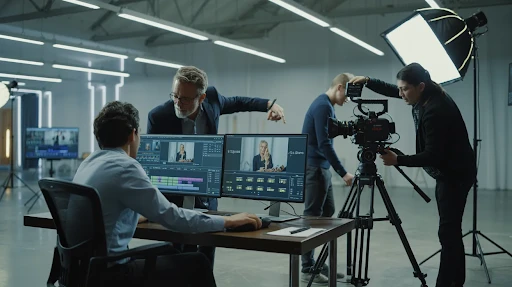
Most strong corporate videos follow a simple path.
First, define the audience. Who is watching?
Next, define the goal. What should they understand or do after watching?
Then shape the message. This is where many projects get weak. Everyone wants their point included. The video starts gaining weight. Soon it feels like a moving brochure.
After that comes production. Filming, interviews, animation, voiceover, screen recording, product shots, motion graphics. Whatever the concept needs.
Then, post-production pulls everything together. Editing, pacing, sound, music, captions, color, revisions.
If you want to create corporate videos that actually get used, do not rush the thinking. A messy concept rarely becomes a great video just because the edit is clean.
Decide Where the Video Will Go Before It Is Finished
This sounds obvious, but teams miss it all the time.
Where will the video live?
Website? Sales email? Paid ad? Internal portal? Social media? Trade show screen? Recruitment page?
The answer changes the video.
A homepage video needs to explain quickly. A sales video can be more specific. A social clip needs to start stronger. A training video may need chapters or shorter modules.
For software companies, a SaaS explainer video company may turn one core idea into several cuts. One for the homepage. One for sales. One for product education. One for short social use.
That kind of planning gives the video a longer life.
Frequently Asked Questions
Final Words
Corporate media production is most effective when it begins with purpose rather than gloss. A corporate video should assist people in understanding, trusting, learning, making decisions, and taking action. That’s the true job. Strong visuals can assist, but only if the message is clear and the video has a destination.
When the aim, format, production method, and distribution strategy all align, corporate video becomes more than just content. It becomes something the business can actually use.
